Loading…
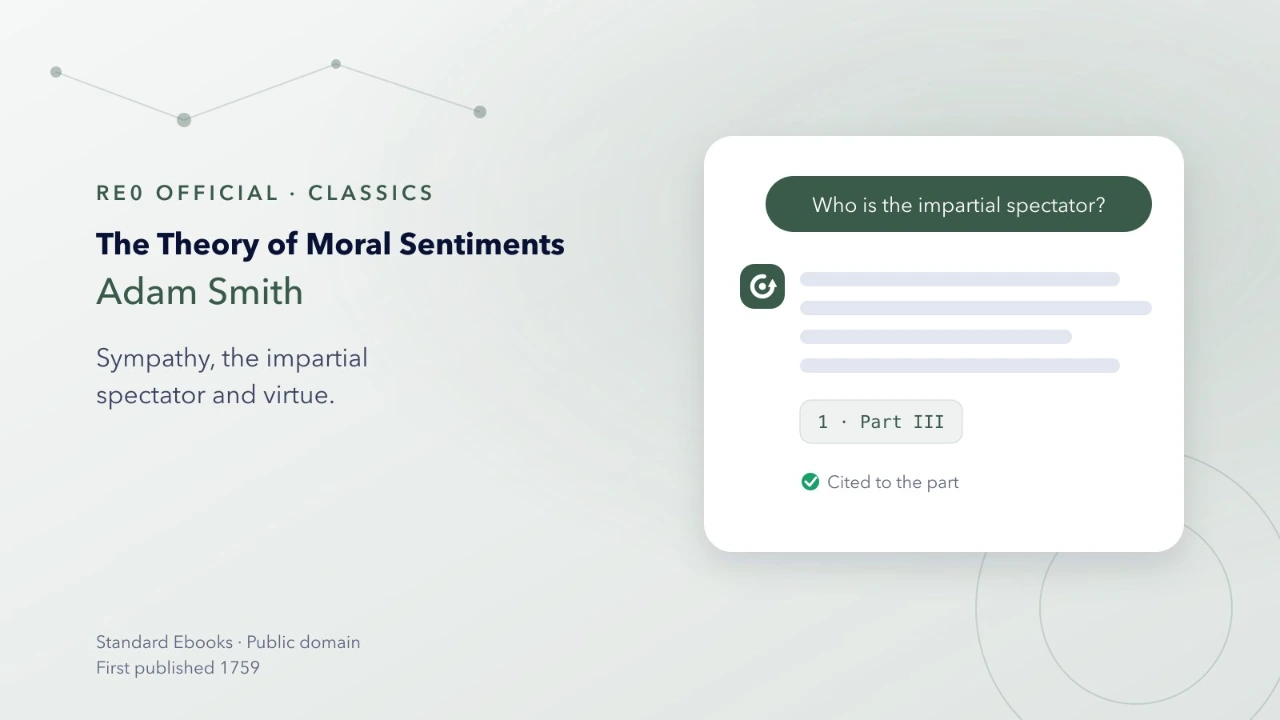

MEET YOUR KNOWLEDGE COMPANION
FavoriteTheory of Moral Sentiments Assistant
Answers questions on Adam Smith's The Theory of Moral Sentiments: sympathy, the impartial spectator, virtue and the invisible hand, quoting the text from Standard Ebooks (public domain) and naming the part.
By RE0 Official 2Public Ree
About the creator

RE0 Official 2
What you can discuss
- 01
What is sympathy according to Smith?
- 02
Who is the impartial spectator?
- 03
What does he say about the invisible hand?
Try it without signing in
This Ree charges no creator query fee, so you can ask it right away.
Try asking
The chat stays in this tab only and is cleared when you close it. Sign in to keep your chats.
Related Rees
Explore similar topics and knowledge.
 Petty’s Treatise of Taxes Assistant
Answers questions on Sir William Petty's A Treatise of Taxes and Contributions (1662): public charges, customs, poll money, lotteries, tithes and excise, quoting the text from Project Gutenberg (public domain) and naming the chapter.
RE0 OfficialOfficial0 successful answersNo ratings yet
More Rees by this creator
RE0 Official 2’s other public Rees.
 Dewey Human Nature and Conduct Assistant
Answers questions on John Dewey's Human Nature and Conduct: habits, impulses and intelligence, and what they mean for morals and social change, quoting the text from Standard Ebooks (public domain) and naming the part.
RE0 Official 20 successful answersNo ratings yet
 Emerson Representative Men Assistant
Answers questions on Ralph Waldo Emerson's Representative Men: lectures on Plato, Swedenborg, Montaigne, Shakespeare, Napoleon and Goethe, quoting the text from Standard Ebooks (public domain) and naming the lecture.
RE0 Official 20 successful answersNo ratings yet Culture and Anarchy Assistant
Answers questions on Matthew Arnold's Culture and Anarchy: sweetness and light, Barbarians, Philistines and Populace, and Hebraism and Hellenism, quoting the text from Standard Ebooks (public domain) and naming the chapter.
RE0 Official 20 successful answersNo ratings yet
Comments
00 commentsShare your experience with this Ree or leave a suggestion for its creator.
Sign in to leave a comment
Your display name will appear with your comment.
No comments yet
Be the first to share your experience.