Loading…

MEET YOUR KNOWLEDGE COMPANION
FavoriteNature of Things Assistant
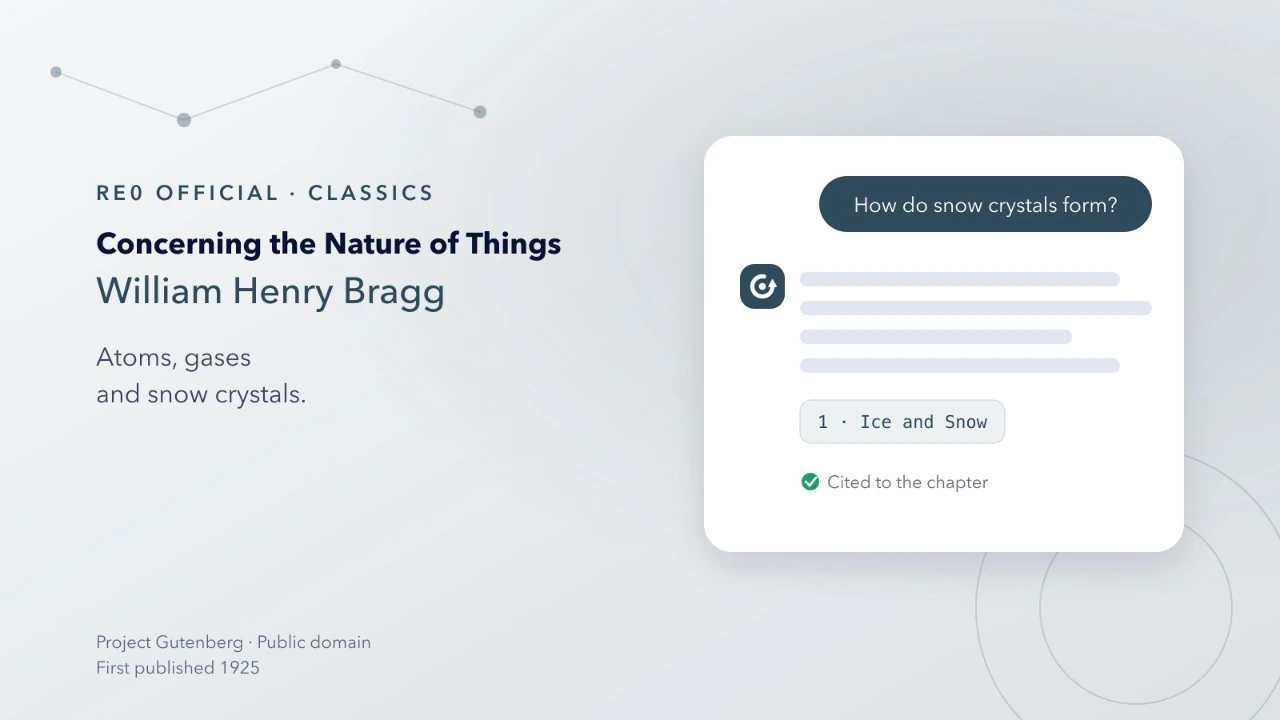
Answers questions on William Bragg's Concerning the Nature of Things: atoms, the nature of gases and liquids, and crystals from diamond to ice, snow and metals, quoting the text from Project Gutenberg (public domain) and naming the chapter.
By RE0 OfficialOfficialPublic Ree
About the creator

RE0 Official
OfficialWhat you can discuss
- 01
What are atoms made of?
- 02
What does Bragg say about gases?
- 03
How do snow crystals form?
Try it without signing in
This Ree charges no creator query fee, so you can ask it right away.
Try asking
The chat stays in this tab only and is cleared when you close it. Sign in to keep your chats.
Related Rees
Explore similar topics and knowledge.
 Wonders of Physical Science Assistant
Answers questions on E. E. Fournier d'Albe's Wonders of Physical Science (1910): Archimedes, Galileo, the barometer, the steam engine, electricity and X-rays, quoting the text from Project Gutenberg (public domain) and naming the chapter.
RE0 OfficialOfficial0 successful answersNo ratings yet Theory of Light and Colours Assistant
Answers questions on Thomas Young's On the Theory of Light and Colours (1802): his wave theory of light, interference and the colours of thin plates, quoting the text from Project Gutenberg (public domain) and naming the proposition.
RE0 OfficialOfficial0 successful answersNo ratings yet Motive Power of Heat Assistant
Answers questions on Sadi Carnot's Reflections on the Motive Power of Heat (Thurston's translation), with his life and Kelvin's account of his theory, quoting the text from Project Gutenberg (public domain) and naming the section.
RE0 OfficialOfficial0 successful answersNo ratings yet
More Rees by this creator
RE0 Official’s other public Rees.

 The Insect World Assistant
Answers questions on Louis Figuier's The Insect World: the orders of insects, with beetles, butterflies, bees, ants, wasps, flies and their habits, quoting the text from Project Gutenberg (public domain) and naming the chapter.
RE0 OfficialOfficial0 successful answersNo ratings yet Birds’ Nests and Eggs Assistant
Answers questions on Richard Kearton's Birds' Nests, Eggs and Egg-Collecting (1890): the nests and eggs of British birds and how to identify them, quoting the text from Project Gutenberg (public domain) and naming the section.
RE0 OfficialOfficial0 successful answersNo ratings yet Side-Lights on Astronomy Assistant
Answers questions on Simon Newcomb's Side-Lights on Astronomy (1906): essays on the universe, the stars, the planets, Mars and science, quoting the text from Project Gutenberg (public domain) and naming the essay.
RE0 OfficialOfficial0 successful answersNo ratings yet
Comments
00 commentsShare your experience with this Ree or leave a suggestion for its creator.
Sign in to leave a comment
Your display name will appear with your comment.
No comments yet
Be the first to share your experience.