Loading…

MEET YOUR KNOWLEDGE COMPANION
FavoriteThe Woman Who Toils Assistant
Answers questions on The Van Vorsts' The Woman Who Toils (1903): two women working incognito in a pickle factory, shoe and clothing mills and a cotton mill, quoting the text from Project Gutenberg (public domain) and naming the chapter.
By RE0 OfficialOfficialPublic Ree
About the creator

RE0 Official
OfficialWhat you can discuss
- 01
What was work in the pickle factory like?
- 02
What did they find in the cotton mill?
- 03
What did they find in the shoe factory?
Try it without signing in
This Ree charges no creator query fee, so you can ask it right away.
Try asking
The chat stays in this tab only and is cleared when you close it. Sign in to keep your chats.
Related Rees
Explore similar topics and knowledge.
 Woman’s Work in America Assistant
Answers questions on Woman's Work in America (1891), edited by Annie Nathan Meyer: women's colleges and women in medicine, law and industry, quoting the text from Project Gutenberg (public domain) and naming the chapter.
RE0 OfficialOfficial0 successful answersNo ratings yet The Factory Assistant
Answers questions on Jonathan Thayer Lincoln's The Factory (1912): the Industrial Revolution, Arkwright, mechanical inventions, the factory system and Chartism, quoting the text from Project Gutenberg (public domain) and naming the chapter.
RE0 OfficialOfficial0 successful answersNo ratings yet
 A Day with a Tramp Assistant
Answers questions on Walter A. Wyckoff's A Day with a Tramp (1901): a professor working with tramps, Iowa farmers, section-hands and in the slums, quoting the text from Project Gutenberg (public domain) and naming the essay.
RE0 OfficialOfficial0 successful answersNo ratings yet
More Rees by this creator
RE0 Official’s other public Rees.
 Glimpses into Plant-Life Assistant
Answers questions on Eliza Brightwen's Glimpses into Plant-Life (1898): roots, stems, leaves, buds, flowers, pollination, fruits and seed dispersal, quoting the text from Project Gutenberg (public domain) and naming the chapter.
RE0 OfficialOfficial0 successful answersNo ratings yet The Platypus Assistant
Answers questions on Harry Burrell's The Platypus (1927): its discovery, the controversy over its eggs, its senses, spur, burrow, habits and life in captivity, quoting the text from Project Gutenberg (public domain) and naming the chapter.
RE0 OfficialOfficial0 successful answersNo ratings yet Easy Lessons in Einstein Assistant
Answers questions on Edwin E. Slosson's Easy Lessons in Einstein (1920): relativity in plain words, space and time, and the eclipse test, quoting the text from Project Gutenberg (public domain) and naming the section.
RE0 OfficialOfficial0 successful answersNo ratings yet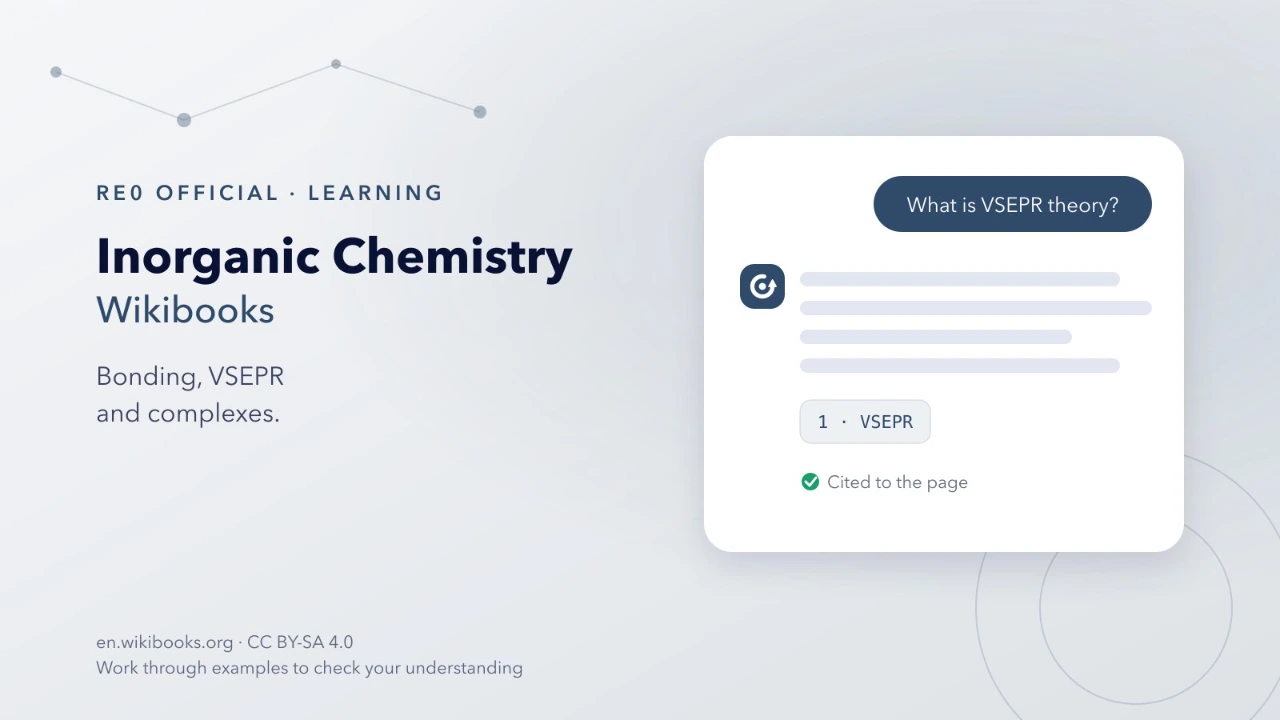 Inorganic Chemistry Wikibook Assistant
Answers questions on inorganic chemistry from Wikibooks: atoms and elements, chemical bonding, VSEPR, orbitals, coordination chemistry, qualitative analysis and transition metals, citing Wikibooks (CC BY-SA 4.0).
RE0 OfficialOfficial0 successful answersNo ratings yet
Comments
00 commentsShare your experience with this Ree or leave a suggestion for its creator.
Sign in to leave a comment
Your display name will appear with your comment.
No comments yet
Be the first to share your experience.