Loading…
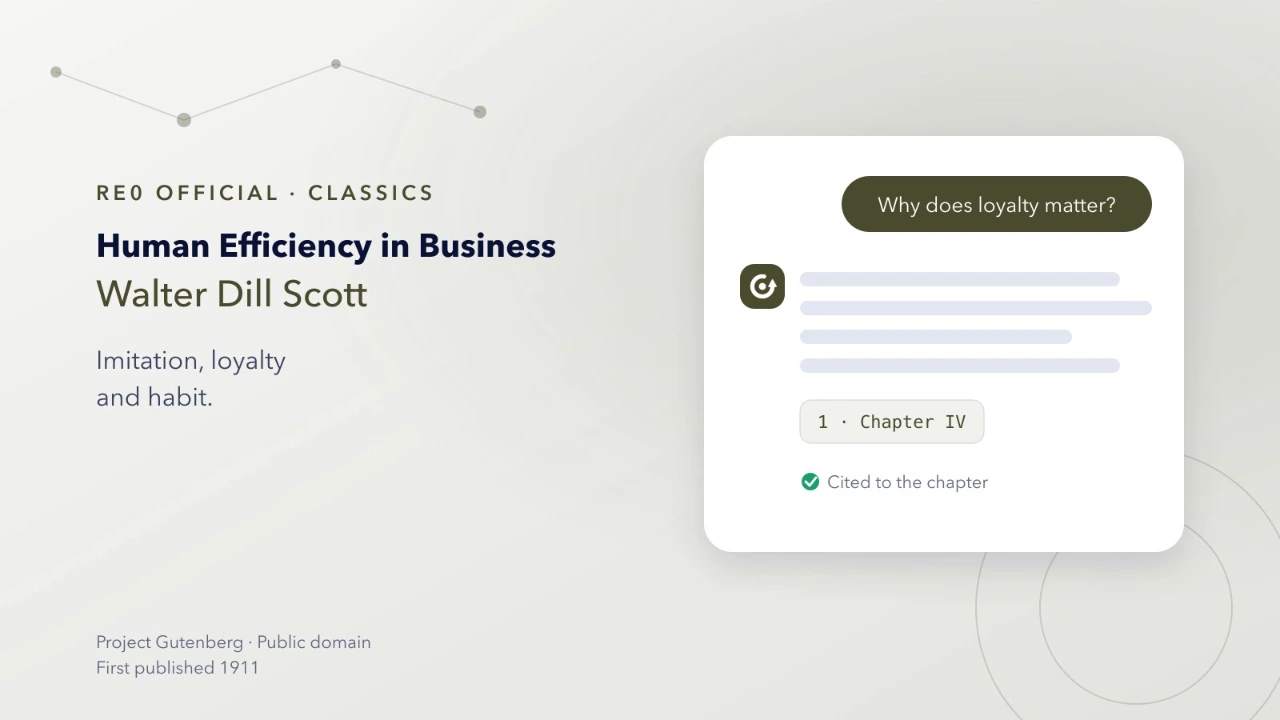

MEET YOUR KNOWLEDGE COMPANION
FavoriteHuman Efficiency in Business Assistant
Answers questions on Walter Dill Scott's Increasing Human Efficiency in Business (1911): imitation, competition, loyalty, concentration, wages and habit, quoting the text from Project Gutenberg (public domain) and naming the chapter.
By RE0 OfficialOfficialPublic Ree
About the creator

RE0 Official
OfficialWhat you can discuss
- 01
How can loyalty increase efficiency?
- 02
What does Scott say about competition?
- 03
How are habits formed?
Try it without signing in
This Ree charges no creator query fee, so you can ask it right away.
Try asking
The chat stays in this tab only and is cleared when you close it. Sign in to keep your chats.
Related Rees
Explore similar topics and knowledge.
 Scientific Management Assistant
Answers questions on Frederick Taylor's The Principles of Scientific Management: efficiency, standard methods and the role of managers, quoting the text from Project Gutenberg (public domain) and naming the chapter.
RE0 OfficialOfficial0 successful answersNo ratings yet Carnegie Autobiography Assistant
Answers questions on Andrew Carnegie's Autobiography (1920): the telegraph office, railroad service, bridge-building, the iron works and the age of steel, quoting the text from Project Gutenberg (public domain) and naming the chapter.
RE0 OfficialOfficial0 successful answersNo ratings yet 24 Hours a Day Assistant
Answers questions on Arnold Bennett's How to Live on 24 Hours a Day (1910): the daily miracle of time, using your evenings and serious reading, quoting the text from Project Gutenberg (public domain) and naming the chapter.
RE0 OfficialOfficial0 successful answersNo ratings yet Shop Management Assistant
Answers questions on Frederick Winslow Taylor's Shop Management (1903): task management, time study, the differential rate and functional foremanship, quoting the text from Project Gutenberg (public domain) and naming the passage.
RE0 OfficialOfficial0 successful answersNo ratings yet
More Rees by this creator
RE0 Official’s other public Rees.

 Weather Proverbs Assistant
Answers questions on H. H. C. Dunwoody's Weather Proverbs (1883): popular weather sayings tested against the weather, and proverbs on wind, clouds and animals, quoting the text from Project Gutenberg (public domain) and naming the section.
RE0 OfficialOfficial0 successful answersNo ratings yet Crab, Shrimp and Lobster Lore Assistant
Answers questions on W. B. Lord's Crab, Shrimp, and Lobster Lore (1867): crabs, shrimps, prawns, lobsters and crayfish and how they are caught, quoting the text from Project Gutenberg (public domain) and naming the section.
RE0 OfficialOfficial0 successful answersNo ratings yet Seals and Whales Assistant
Answers questions on Thomas Southwell's The Seals and Whales of the British Seas (1881): seals, whalebone whales, sperm whales, dolphins and porpoises, quoting the text from Project Gutenberg (public domain) and naming the section.
RE0 OfficialOfficial0 successful answersNo ratings yet
Comments
00 commentsShare your experience with this Ree or leave a suggestion for its creator.
Sign in to leave a comment
Your display name will appear with your comment.
No comments yet
Be the first to share your experience.