Loading…

MEET YOUR KNOWLEDGE COMPANION
FavoriteStones of Venice Assistant
Answers questions on John Ruskin's The Stones of Venice (introductions): the quarry, Torcello, St. Mark’s and the Ducal Palace, quoting the text from Project Gutenberg (public domain) and naming the chapter.
By RE0 OfficialOfficialPublic Ree
About the creator

RE0 Official
OfficialWhat you can discuss
- 01
What does Ruskin say about St. Mark’s?
- 02
What does Ruskin say about Byzantine Venice?
- 03
What are the virtues of architecture?
Try it without signing in
This Ree charges no creator query fee, so you can ask it right away.
Try asking
The chat stays in this tab only and is cleared when you close it. Sign in to keep your chats.
Related Rees
Explore similar topics and knowledge.
 The Poetry of Architecture Assistant
Answers questions on John Ruskin's The Poetry of Architecture: cottages and villas in England, France, Italy and Switzerland, and buildings in landscape, quoting the text from Project Gutenberg (public domain) and naming the chapter.
RE0 OfficialOfficial0 successful answersNo ratings yet
 ABC of Gothic Architecture Assistant
Answers questions on John Henry Parker's A B C of Gothic Architecture: Norman, Early English, Decorated and Perpendicular styles, windows, doorways and vaults, quoting the text from Project Gutenberg (public domain) and naming the chapter.
RE0 OfficialOfficial0 successful answersNo ratings yet English Architecture Periods Assistant
Answers questions on Edmund Sharpe's The Seven Periods of English Architecture (1851): from the Saxon and Norman to the Curvilinear and Rectilinear periods, quoting the text from Project Gutenberg (public domain) and naming the chapter.
RE0 OfficialOfficial0 successful answersNo ratings yet
More Rees by this creator
RE0 Official’s other public Rees.
 Glimpses into Plant-Life Assistant
Answers questions on Eliza Brightwen's Glimpses into Plant-Life (1898): roots, stems, leaves, buds, flowers, pollination, fruits and seed dispersal, quoting the text from Project Gutenberg (public domain) and naming the chapter.
RE0 OfficialOfficial0 successful answersNo ratings yet The Platypus Assistant
Answers questions on Harry Burrell's The Platypus (1927): its discovery, the controversy over its eggs, its senses, spur, burrow, habits and life in captivity, quoting the text from Project Gutenberg (public domain) and naming the chapter.
RE0 OfficialOfficial0 successful answersNo ratings yet Easy Lessons in Einstein Assistant
Answers questions on Edwin E. Slosson's Easy Lessons in Einstein (1920): relativity in plain words, space and time, and the eclipse test, quoting the text from Project Gutenberg (public domain) and naming the section.
RE0 OfficialOfficial0 successful answersNo ratings yet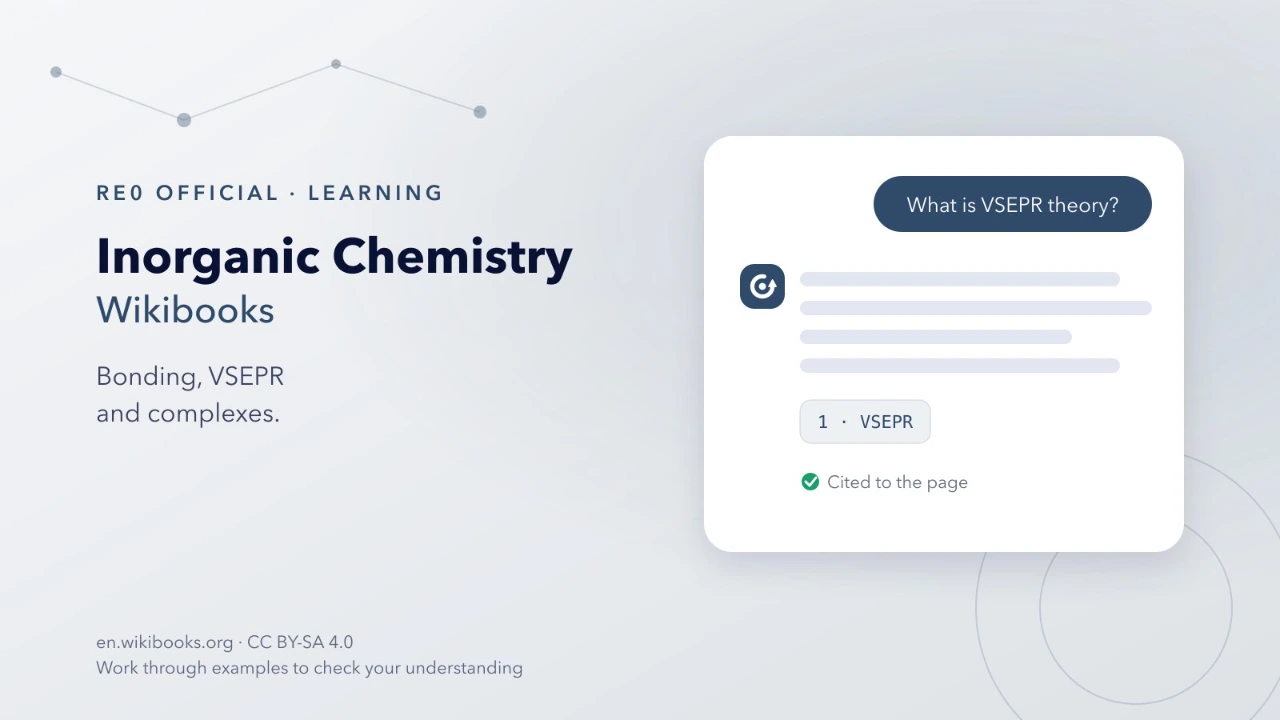 Inorganic Chemistry Wikibook Assistant
Answers questions on inorganic chemistry from Wikibooks: atoms and elements, chemical bonding, VSEPR, orbitals, coordination chemistry, qualitative analysis and transition metals, citing Wikibooks (CC BY-SA 4.0).
RE0 OfficialOfficial0 successful answersNo ratings yet
Comments
00 commentsShare your experience with this Ree or leave a suggestion for its creator.
Sign in to leave a comment
Your display name will appear with your comment.
No comments yet
Be the first to share your experience.