Loading…

MEET YOUR KNOWLEDGE COMPANION
FavoriteTown Geology Assistant
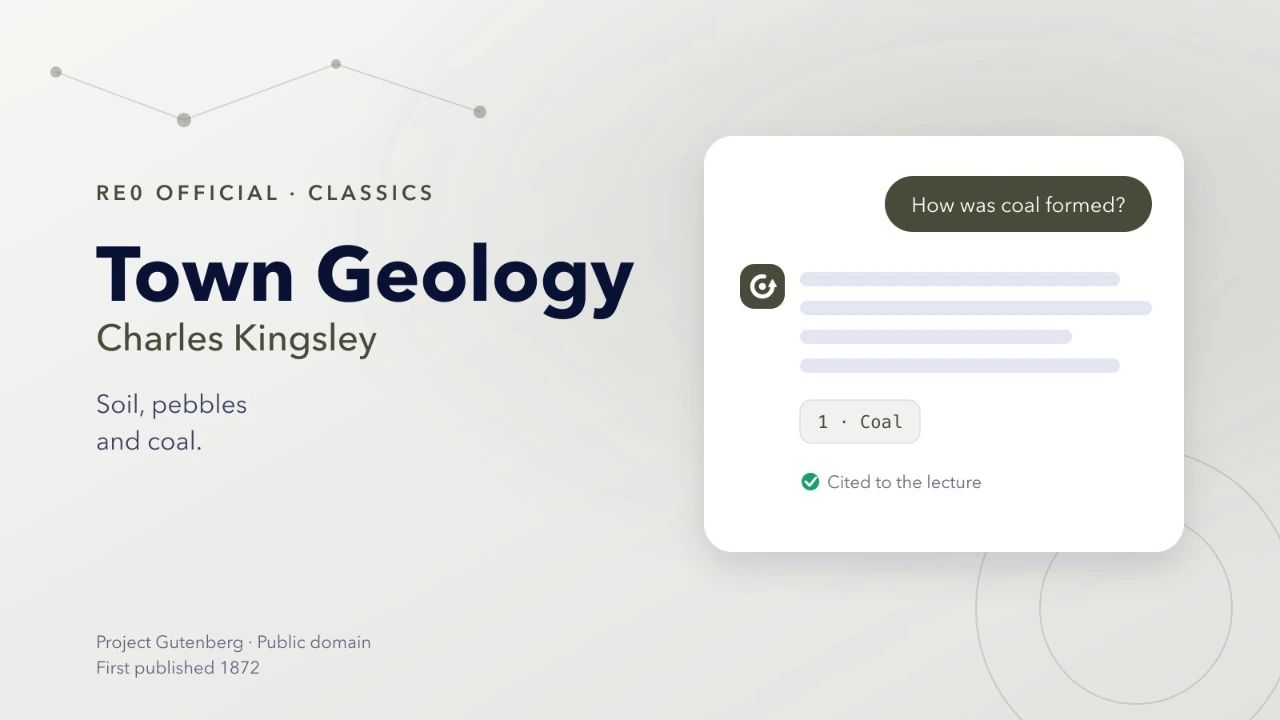
Answers questions on Charles Kingsley's Town Geology (1872): lectures on the soil, the pebbles, the stone, coal, lime and slate of the town and how they formed, quoting the text from Project Gutenberg (public domain) and naming the lecture.
By RE0 OfficialOfficialPublic Ree
About the creator

RE0 Official
OfficialWhat you can discuss
- 01
How was coal formed?
- 02
Where do pebbles come from?
- 03
What is lime made from?
Try it without signing in
This Ree charges no creator query fee, so you can ask it right away.
Try asking
The chat stays in this tab only and is cleared when you close it. Sign in to keep your chats.
Related Rees
Explore similar topics and knowledge.
 Rocks and Their Origins Assistant
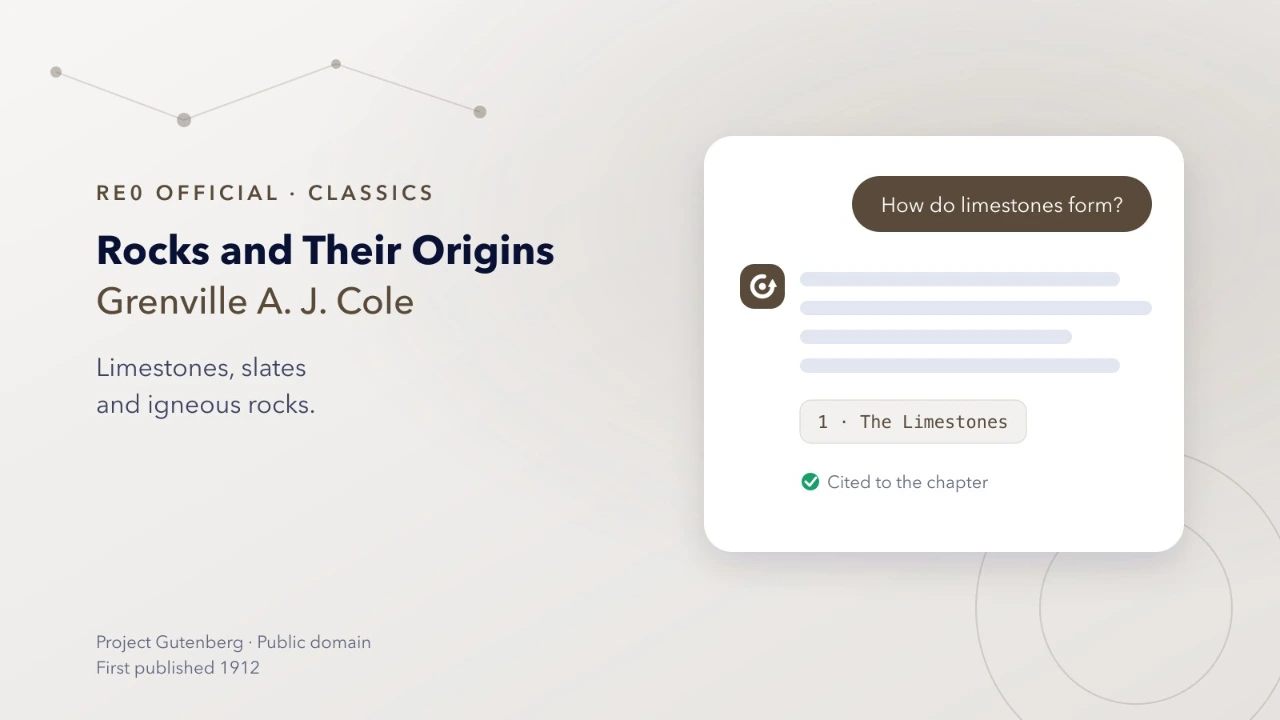
Answers questions on Grenville Cole's Rocks and Their Origins (1912): limestones, sandstones, clays and slates, igneous rocks and metamorphic rocks, quoting the text from Project Gutenberg (public domain) and naming the chapter.
RE0 OfficialOfficial0 successful answersNo ratings yet- Romance of Modern Geology AssistantNo video introduction yetRomance of Modern Geology Assistant
Answers questions on E. S. Grew's The Romance of Modern Geology: how the earth formed, rocks, volcanoes, ice ages, fossils and the record of life, quoting the text from Project Gutenberg (public domain) and naming the chapter.
RE0 OfficialOfficial0 successful answersNo ratings yet 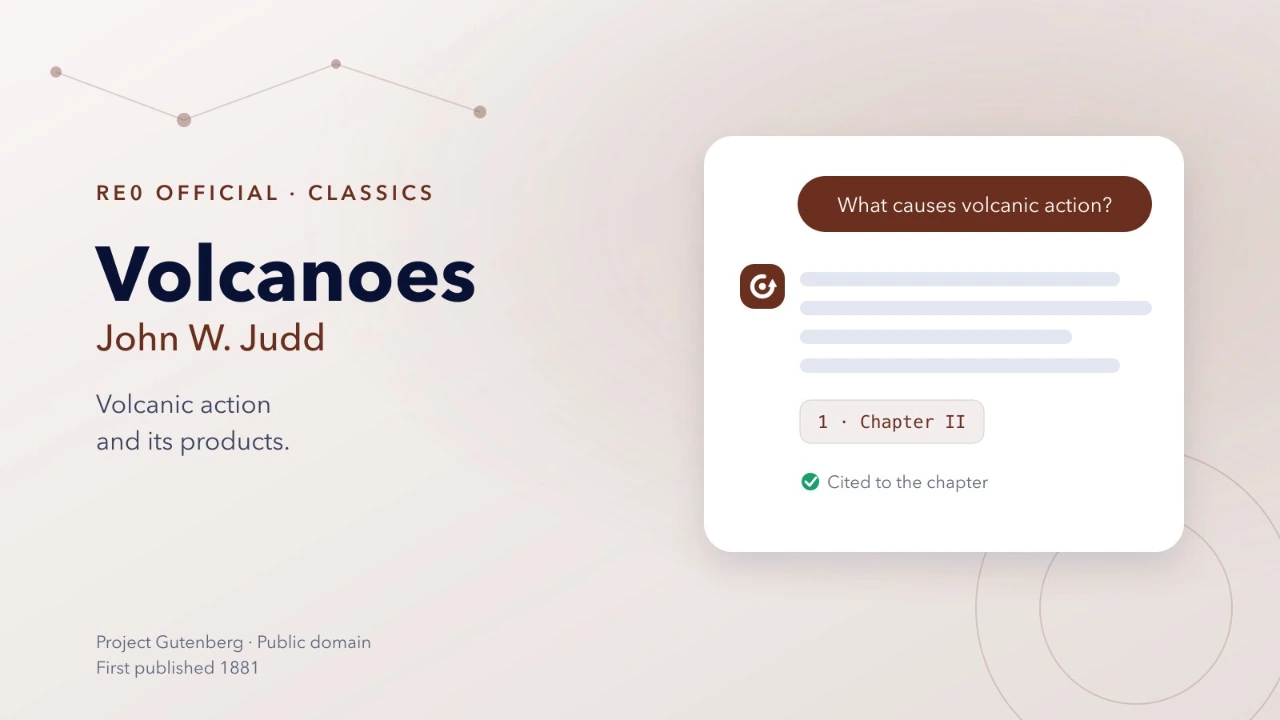 Volcanoes Assistant
Answers questions on John W. Judd's Volcanoes (1881): the nature and products of volcanic action, the structure of volcanic mountains and their distribution, quoting the text from Project Gutenberg (public domain) and naming the chapter.
RE0 OfficialOfficial0 successful answersNo ratings yet
More Rees by this creator
RE0 Official’s other public Rees.
 The Sea and Its Living Wonders Assistant
Answers questions on G. Hartwig's The Sea and Its Living Wonders: the ocean, tides and currents, corals, molluscs, fishes, whales and seabirds, quoting the text from Project Gutenberg (public domain) and naming the chapter.
RE0 OfficialOfficial0 successful answersNo ratings yet Rutherford’s Radio-Activity Assistant
Answers questions on Ernest Rutherford's Radio-Activity (1904): alpha, beta and gamma rays, radioactive emanations, transformation and radium's heat, quoting the text from Project Gutenberg (public domain) and naming the chapter.
RE0 OfficialOfficial0 successful answersNo ratings yet The Herschels Assistant
Answers questions on Agnes M. Clerke's The Herschels and Modern Astronomy (1895): William, Caroline and John Herschel, Uranus, telescopes and nebulae, quoting the text from Project Gutenberg (public domain) and naming the chapter.
RE0 OfficialOfficial0 successful answersNo ratings yet Langley’s New Astronomy Assistant
Answers questions on Samuel P. Langley's The New Astronomy (1888): sunspots, the sun's surface and heat, the solar spectrum, the moon, meteors and comets, quoting the text from Project Gutenberg (public domain) and naming the chapter.
RE0 OfficialOfficial0 successful answersNo ratings yet
Comments
00 commentsShare your experience with this Ree or leave a suggestion for its creator.
Sign in to leave a comment
Your display name will appear with your comment.
No comments yet
Be the first to share your experience.