Start with a question. Find knowledge that understands.
“Confucius” · 5 ReesMatched against knowledge: the 10 most relevant. Excerpts come from the matching passage.
Ask the top 3 Rees togetherThe Analects Assistant · A Short History of the World Assistant · The Art of War Assistant — Start a conversation that sends this question to all of them. Once two or more answer, synthesize their answers in one click.
Answers questions on the Analects of Confucius, sayings on learning, virtue and government, quoting James Legge's English translation from Project Gutenberg (public domain) and naming the book.
Answers questions on H. G. Wells's A Short History of the World, from the origins of life and the first civilisations to the First World War, quoting the text from Project Gutenberg (public domain) and naming the chapter.
“The gist of the teaching of Confucius was the way of the noble or aristocratic man. He was concerned with personal conduct as much as Gautama was concerned with…”
Answers questions on Sun Tzu's The Art of War, quoting Lionel Giles's 1910 translation from Project Gutenberg (public domain) and naming the chapter.
“… authority of the Classics:— Our Master Confucius, answering Duke Ling of Wei, said: "I have never studied matters connected with armies and battalions." [62] R…”
Answers questions on Lao-tzu's Tao Te Ching, on the Way and its virtue, quoting James Legge's 1891 English translation from Project Gutenberg (public domain) and naming the chapter.
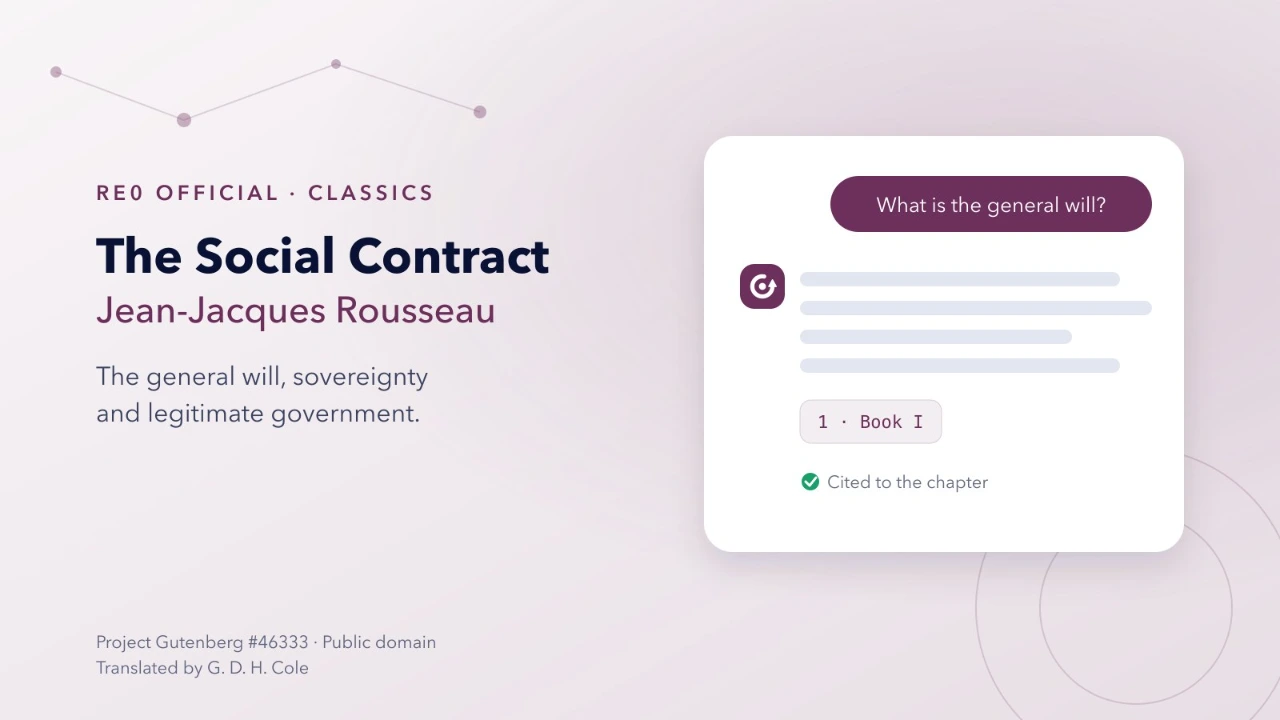
Answers questions on Rousseau's The Social Contract: the general will, sovereignty and legitimate government, quoting G. D. H. Cole's translation from Project Gutenberg (public domain) and naming the book.
“"None of us, neither the sophists, nor the poets, nor the orators, nor the artists, nor I, know what is the nature of the *true*, the *good*, or the *beautiful*…”
1 knowledge sourcesRE0 OfficialOfficial
20credits / answer
0Successful answersNo ratings yetPositive ratings
Your knowledge deserves a Ree of its own.
Start with a source. Turn experience into a conversation.